Q-LEAK
Quantum sensing for the smallest warning signs
Q-LEAK explores whether quantum-enhanced optical sensing can identify trace methane and hydrogen leaks across demanding transport infrastructure.

Detecting risk before it becomes visible
Hydrogen and methane can escape in concentrations too low for conventional systems to identify reliably at distance. In rail depots, tunnels and refuelling networks, earlier detection could materially improve safety and environmental control.Q-LEAK is a feasibility study combining squeezed-light interferometry, entangled-photon detection and responsible AI signal processing.
Project overview
Lead: Bellacet Ltd
Duration: 3 months
Focus: Feasibility study
Location: United Kingdom
Trace leaks are hard to separate from noise
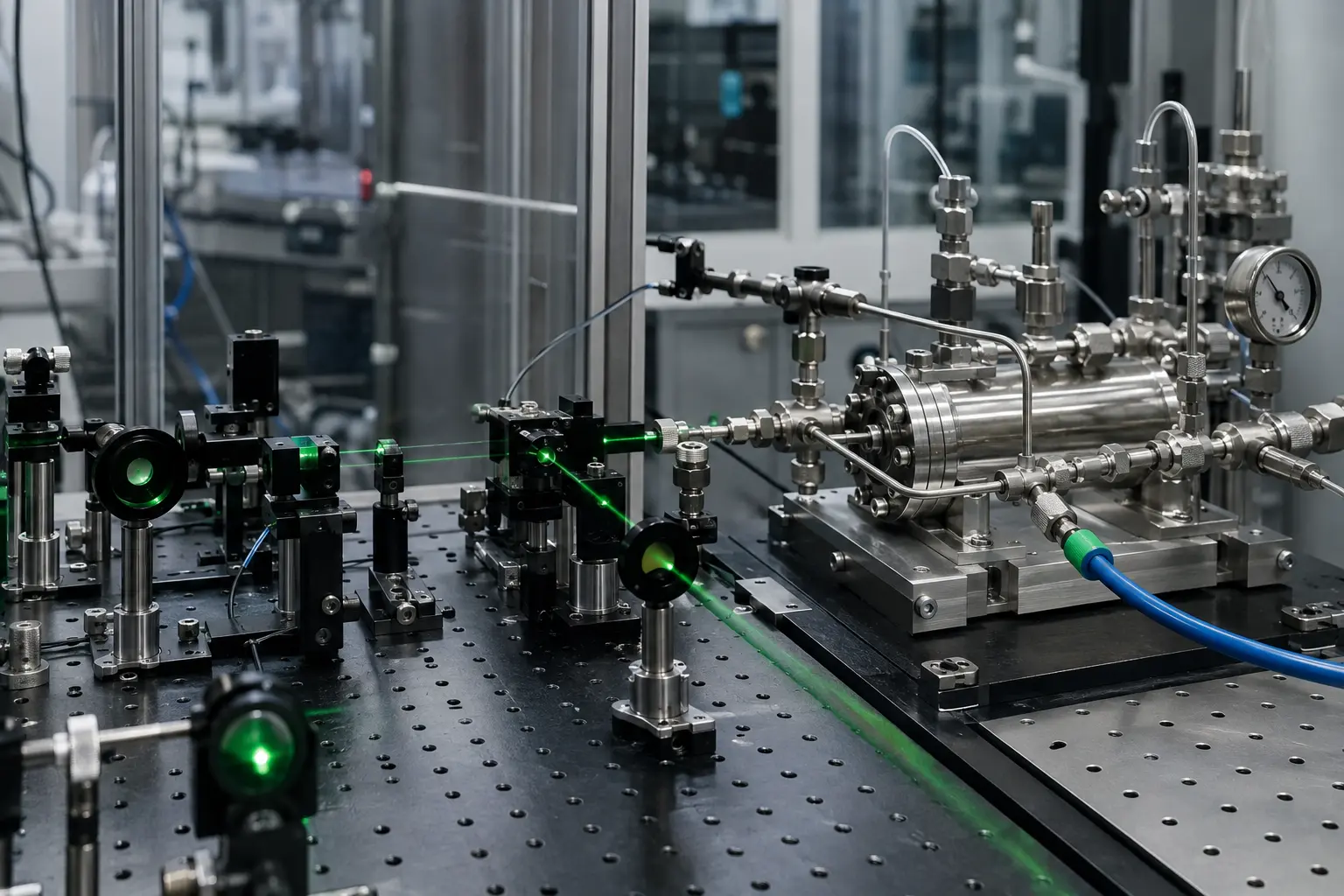
Long optical paths, vibration, temperature change and complex industrial backgrounds can obscure weak gas signatures. Higher sensitivity alone is not enough if alerts cannot be trusted or explained.The project therefore examines both the quantum measurement approach and the denoising, calibration and decision logic needed for useful field operation.
The feasibility questions
Quantum sensitivity
Assessing whether optical quantum techniques can support sub-ppm detection over useful distances.
Explainable alerts
Using responsible AI to reduce noise while preserving a traceable reason for every warning.
Infrastructure fit
Testing assumptions against depots, tunnels and hydrogen refuelling environments.

From laboratory principle to field case
Q-LEAK will define the sensing architecture, operating assumptions and practical constraints that matter outside a controlled laboratory.The study will compare achievable sensitivity with deployment factors such as alignment, vibration, calibration and maintenance.The outcome will be a grounded decision on the most credible route toward a demonstrator for safer, lower-emission transport infrastructure.